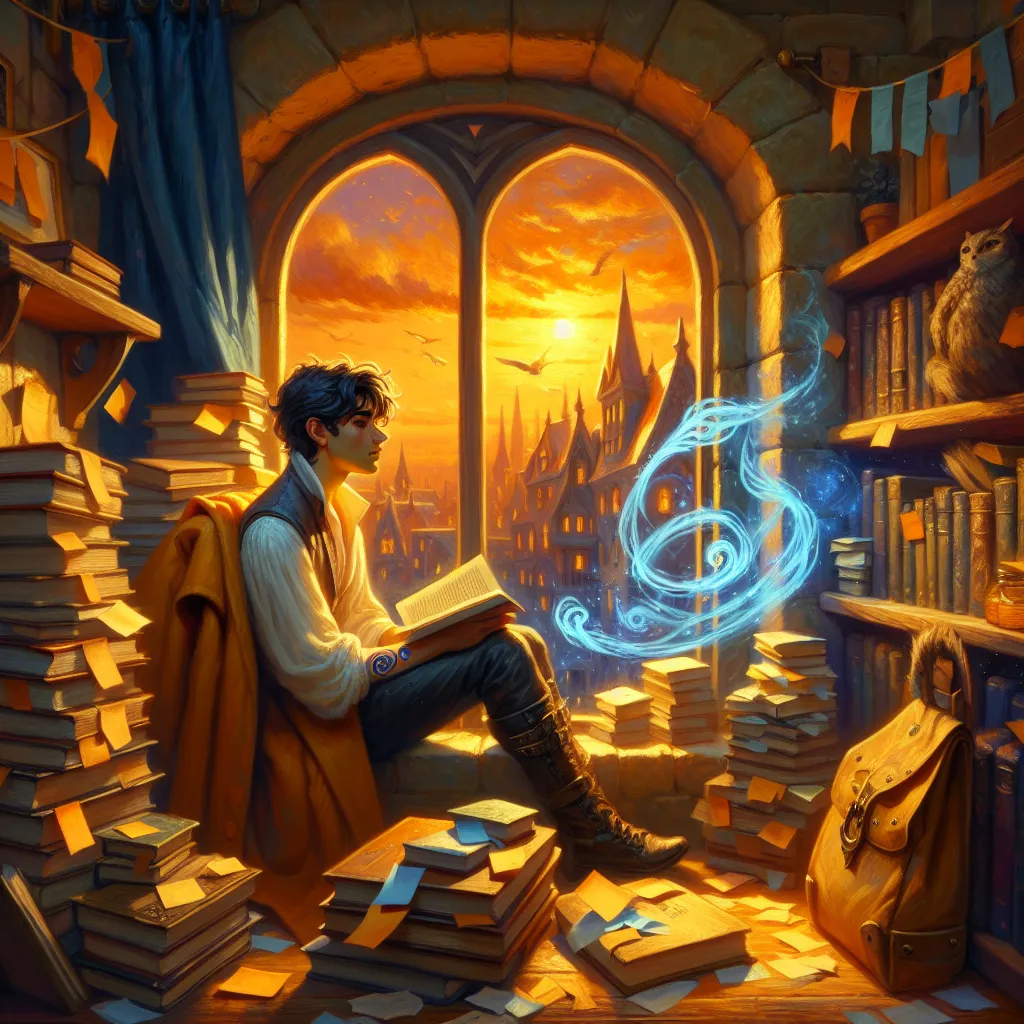
The Seeker's Ledger
Johny was an okay guy. Not remarkable, not unlucky, not especially charming—just steady enough to hold a part-time job and a battered paperback collection that smelled faintly of rain and cheap coffee. He read fantasy like people breathed: constantly, compulsively. He knew the arcs, the tropes, the way power progression tended to look suspiciously like a spreadsheet with swords. He knew exactly what would happen when a hero strode into a new world—how townsfolk cheered, how the king handed out quests, how the protagonist suddenly learned a world‑saving skill between lunch and tea.
Which is why, when a truck hit him on an empty, rain-slicked crosswalk and everything went white, Johny chuckled.
Not an ironic laugh. A tiny, dry, incredulous sound that came from somewhere under his ribs, as if even fate had a sense of humor he couldn't afford. When he opened his eyes, he was not in the hospital, not in a bed with fluorescent lights. He was lying on grass that smelled like cut hay and wild mint, and the sky leaned over him like a painted backdrop, impossibly blue and too clean.
A woman in a courier's cap elbowed a man in plate armor and said, very loudly, "Watch where you summon people, Gahriel! That's the third lost item this week."
Johny sat up. He tried to stand, thought of his knees and decided not to, because they felt like someone had replaced them with overcooked noodles. The courier—who had hair the color of copper coins and an expression that read "always ten minutes late for disaster"—squinted at him.
"You look like an NPC," she said, which was not encouraging. "Which one are you? Victim, lost child, reluctant hero, massive plot device?"
"I—" Johny began. It felt absurd but comforting to say it. "I read a lot of fantasy. I think I got hit by a truck."
The armored man had bright eyes like studio lights. "Truck-kun," he announced reverently. "Legendary transporter of fate and improperly parked cosmic vehicles."
"He's from Earth," the courier added, because of course she had to finish the joke. "He looks... ordinary."
"Ordinary," said a voice like velvet and thunder. A figure detached itself from the trees: tall, robes black as a spilled night, eyes like two chips of moonlight. A mage. Not the kind from covers—this one had wrinkles like a map and a staff with something living at its tip, a small glow that looked suspiciously like an annoyed cat.
"I am High Chancellor Lys," she declared. "We will determine the appropriate classification. Hero, herald, walking prophecy—"
"I don't want to be a prophecy," Johny said. "Can I be a guest? Temporary? I could cough melodramatically and die a hero—"
"You're in a summoned zone," the armored man said, balancing a gauntleted hand on Johny's shoulder. "You have the mark."
He pulled back the cuff. Beneath the dirt on Johny's wrist, a spiral of faint, ink-blue lines pulsed like slow lightning. It wasn't a tattoo—those lines felt like a promise someone had made to his skin.
Around them, small faces peered from behind a hedge. A girl in a patched green tunic with ears that twitched like a rabbit's held a basket of mushrooms and looked delighted. "A story person!" she whispered. "Maybe he's the one from the tavern rumor. He'll know the cure for dad's knees."
"He's definitely not the one the prophecy specified," Lys said. "The prophecy named a 'Seeker of the Fifth Sun.' This mark—" she tapped the lines with a nail the color of new copper—"this is a Summoners’ Loop. Either he was drawn through by accident, or—"
"—someone screwed up the ritual," courier said, with the weary patience of someone who had seen rituals go sideways more times than she cared to count. "Or the truck is a deity with commitment issues."
Johny wanted to tell the tall woman that fate probably had a union representative for such things. Instead he coughed, which sounded like a small appliance giving up on life.
They took him to the nearest town. It was one of those places straight out of the pages he loved: cobblestones that gleamed when you weren't watching, a bakery with a bell that chimed in notes that made people hug, and a notice board that smelled of old gossip and sticky pastry crumbs. Johny felt a keen, ridiculous pleasure in it. He recognized the way the blacksmith's apprentice shoved a hammer with both of his hands like he was trying to coax thunder out of iron. He recognized the way the innkeeper winked at every stranger as if winking were currency.
But story logic is not the same as real logic. The innkeeper did not fling him a room and a key. He flung him to the guild.
Guilds in this world were like cafés for people with tragic backstories and discount magic. The board above the counter clattered with requests: deliver a parcel to a widow three days' ride away, investigate lights in the old tower, capture a goblin whose latest job was interior decorating and chaos. Johny squinted at the chalkboard as if he'd find instructions under "Investigate the old tower" like a fold-out map.
"Any new recruits?" he asked, making it sound as if he had come in with a business plan and an introductory handshake.
"Depends," said a woman with ink-stained fingers and the expression of someone who'd filed the same form five thousand times. "What are your skills?"
He had rehearsed this in the hospital, in his head: sword, stealth, rudimentary fire magic learned between page 196 and 198. On the page, the hero always chose three things: a skill, a flaw, and a special move called something dramatic like "Blazing Gale of Destiny."
Johny blinked at the woman. "I have... an appreciation for narrative structure? I can fold a map nicely?"
She considered him like a test subject. "We usually like basic competencies. Literacy helps. Can you read?"
"Extremely." He felt a flush of pride. In every life he read, the hero's literacy was the thing that saved the day—except in some swords-and-sandals epics where literacy was suspiciously rare.
"Then you can be paperwork," she said. "Keep parchment. File missing pet reports. And—" she squinted—"you can go on low-risk errands."
Errands, Johny learned, were the economy's version of training wheels. You fetched herbs from crooked hedges, you walked angry dogs, you delivered—once—to a necromancer who insisted she only needed a 'few' pages of fresh gossip. You were in proximity to adventure without the mortality rate.
He learned quickly. Not because he had a destiny tattooed on his back or a sword that hummed with cosmic righteousness. He learned because he read. He read every notice, every guild regulation, every elderly widow's story that came with a teacup and a trembling finger. Knowledge that was useless in the real world—how to identify three poisonous mushrooms that looked identical, how to calm a horse that thought dragonfly-sparkles were a personal affront—became useful here.
A nervous, lanky archer named Mira taught him how to straddle a saddle without sending himself into a ditch. A grizzled veteran who'd been a hero too early taught him how to carry a torch without catching his eyebrows afire. High Chancellor Lys taught him a form of magic that did not make anything explode: Knotcraft. It was a discipline of tying spells with intent; the knots were temporary, elegant, and used for fixing things—ropes, locks, broken promises.
The best thing about the guild was the people. The bakery boy who sang nonsense verse at three in the morning while icing tarts. The old woman who claimed to be a retired dragon (and may or may not have been). The courier who explained, over a pot of stew, that heroes were overrated but people were not. Every small kindness—sharing soup, tucking a cloak around shoulders, reading aloud by the fire—built something that no prophecy could quantify: a quiet, threaded community.
Johny's life in the guild was small and warm. He mended a suspicious number of socks. He became the unofficial consultant for "What would the hero do?"—a question people asked not because he was heroic but because his bookshelf brain could emulate heroic pattern-recognition. When the mayor's cat went missing (cats being a thing of high diplomatic importance in this town), Johny applied his theory of narrative necessity and staked out the baker's shed, where he found the cat napping with three stolen rolls.
"You're a regular legend," Mira teased, and he took it as the compliment it was meant to be.
Of course, a fantasy world can't leave things in gentle equilibrium. The equilibrium had to tilt, and then smash a few crockery plates on the way down. It began with a rumor—a candlewick speech, murmured in a market where arguments about pie heated faster than the oven.
"They say the Fifth Sun is waking," a traveling peddler said, eyes darting like dice. "The earth trembles in the east. People dream of fire that isn't fire."
"And the hero?" someone asked.
"The hero? He will be called," the peddler said. "Or she. Or they. The prophecy will choose."
Johny felt a chill. Prophecies made people expect things; expectations did terrible things to people who could hold them. He had come to value the smallness of tasks, the idea that you could make a life out of doing tiny things well. If a prophecy arrived, it would erase the years of building he and the guild had done—publicity, pageantry, decisions made by people who didn't know better.
Days later, a burn-scarred knight arrived in town, a retinue of banners snapping under his arm. He bore a sword that seemed to swallow sunlight and a proclamation that announced, with theatrical certainty, that the Seeker of the Fifth Sun had been located nearby. He had been promised a hero by some very bureaucratic cosmic force, and he intended to find them.
Johny watched the knight strut through the market and thought of the Summoners’ Loop on his wrist. He could feel people looking at him like a book of fate. He wanted, irrationally, to walk back to his old town, to his old life, to his coffee-stained chair and the comfort of stories safely confined to pages.
Instead, he put on his jacket and walked toward the square.
"You're going to declare it yourself?" Mira said later, after they'd attended a town council meeting where Johny had been stared at long enough to feel like an exhibit.
"I could," Johny replied. "Or I could—" He stopped, unsure how much of his old life to map onto this new one. "—I could say no. Maybe not every person needs to be the center of a story. Maybe it's okay to be the person who patches it up."
"But the knight—" Mira frowned. "He won't take 'no' for an answer. Not from a bookworm."
"No," Johny said. "He won't. But there's a world here that seems to work on momentum. If he finds a 'hero' he'll drag the whole town into armageddon tourism. We fix small things. We keep people alive. We heal."
The knight found them at dawn, as knights tend to do. "I seek the Seeker of the Fifth Sun," he boomed. "The prophecy hath spoken. Step forward, child of destiny."
Johny looked at him—at the sword, the banners, the dramatic twirl a seasoned soldier does when expecting bows. He stepped forward and, for reasons he couldn't entirely articulate, told the truth.
"I'm not the Seeker," he said. "I'm Johny. I make lists. I fix sock holes. I read fantasy for news."
There was a beat of shocked silence, then a ripple of laughter. Some of it was cruel, some of it delighted. The knight's face reddened. "The mark!"
He lifted the cuff of Johny's sleeve, showed the council the glowing spiral. It pulsed, innocuous as a button. Lys's face darkened. The knight's jaw set.
"Summoned," he said, as if the presence of a mark reduced the complexities of the world to a slogan. "You will come with me. The Seeker must be escorted to the Sun Altar."
There was an uproar. Johny's protests sounded like a man explaining that a dragon was allergic to baubles. "I can—"
"You are selected," the knight said. "Don't fight destiny. Destiny bites."
Johny went because there was no polite way to refuse a man with a banner and a timetable. He went because leaving would mean something worse—leaving would mean he had to watch his friends dragged into stories beyond their depth.
Their journey east was a study in pinging anxieties. The road smelled of iron and rain. The Sun Altar lay in a valley where the grass shimmered like hot breath; travelers said the horizon itself hummed when the Sun woke. Along the way, Johny noticed small things magic didn't prepare you for: children who had never seen a robin, families who had learned to store hope like a commodity, gardens fenced with prayer more than wood.
At the camp one night, Lys sat with Johny behind a kettle of tea, watching the fire sputter. "You are not what you expected," she observed.
"I had an image," Johny admitted. "Sword, cape, people weeping with gratitude."
"Most images are inaccurate," Lys said. "But you are teaching people to notice small repairs. That matters. The world doesn't only need those who can swing swords. It needs those who can tend to the bleeding afterward."
He thought of his old life: bills paid in clumsy increments, friends with good hearts, the comfort of pages. He thought of the guild: the bakery boy's ridiculous rhymes, Mira's awkward courage, Lys's quiet knots of magic. "What if people expect the Seeker to be a hero?" he asked. "What happens if the prophecy is misread?"
"Then you find a way to read it properly." She looked at him, and for a moment Johny saw the exhaustion of someone who had been rewriting interpretations for decades. "We do not have to answer the world's oldest questions in its loudest voice."
They reached the Sun Altar under a sky that tasted of ozone. People gathered: common folk with lanterns, merchants in half-mourning for lost coin, priests gripping rosaries. The knight announced the arrival of the Seeker. He bade Johny to step onto the circle of stone. Johny's knees felt like they did when standing at the edge of a high cliff in the books: the world seemed to hold its breath.
He stepped forward. The stone accepted him like an old friend. Light bled out of the spiral on his wrist, warm as baked bread.
Then something odd happened. The sunlight around them flickered, not in cosmic paradox but like a theater light struggling with bad wiring. The altar shivered, released a breath of wind like someone opening a window. A voice—that old archaic kind of voice that sounds like a well-read ledger—spoke from nowhere and everywhere.
"Seeker of the Fifth Sun," it intoned.
Johny, who had thought to be witty in the face of world-altering pronouncements, advanced a practiced protest. "I—"
"Come forward," the voice said. "Claim the calling."
It expected him to claim it. To accept a role painted so broadly that it would swallow him. He felt the weight of hundreds of stories pressing on his shoulders, each one eager to shape him. He tasted the idea of becoming a center, of having purpose, and it shone like clean metal.
He also tasted the memory of small things. Mira's laugh when she missed a shot. The bakery boy's ridiculous rhymes. The way Lys's Knotcraft had mended a broken child's toy when the child thought repair was a myth. He had come to love a patchwork of small, steady acts. He was not a blank slate; he had a ledger of debts and small, repeated kindnesses.
"Prophecy," he said, out loud, because he could feel the town leaning in, "has a habit of turning people into ideas. I read a lot of stories. They end half the world by mistake."
Silence followed. The knight's fist tightened on his sword. The wind held its breath.
The voice was patient. "To refuse the calling is theft. The sun will rise and stumble without its seeker."
Johny considered three ways the world could go: the 'hero takes mantle, saves everyone', the 'hero takes mantle, causes chaos via misused power', the 'hero refuses, world collapses.' He had read all three. He had also read stories where a hero's true power was the ability to choose how others' stories ended.
"Okay," he said. "I'll accept, on one condition."
There was a stir. Lys's eyebrows climbed like a conspiracy.
"Tell me the rules," Johny said. "If I'm the Seeker, I get to know what that means. I get to ask questions. I get consent from the people who will be affected. No unilateral declarations—no forced quests that steamroll entire villages. If there's a choice, the people who live with it get to make it."
The voice was silent for a long, rigid moment. It was not accustomed to being bargained with. When it answered, the sound was like a door opening after years of sitting shut.
"Terms are not typically permitted," it said. "But it is curious, and the craft of negotiation is a human one. Speak your conditions."
Johny's terms were strange: a council to approve any citywide interventions, an allowance for mistakes, a public apology clause for any consequences that came from heroic acts, and—his most unlikely request—a formal requirement that the Seeker maintain a habit of reading for one hour every day, to ensure clear judgment.
Laughter rippled through the crowd, disbelief and amusement tangling. Then Lys, who had been carefully balancing centuries of ritual, nodded slowly.
"Wise," she murmured. "Hubris is a predictable hazard. Contractual obligations are not heroic, but they are stabilizing."
The voice agreed, partly because it found the negotiation entertaining and partly because it wanted a Seeker who would not turn the world to brittle ash. Johny, to his own surprise, felt a cautious relief.
He left the altar with a title—Seeker of the Fifth Sun—and a small, practical list of responsibilities. The town celebrated as if nothing had changed, because in many ways, nothing had to change. The knight, chastened by having been outmaneuvered by a man who smelled faintly of old paper, took himself back to his banners. He called Johny foolish and daring in equal measure.
Johny's office—yes, the Seeker's office—was a corner of the guildhall, near the noticeboard, with a window that let in a brook-of-light every morning. He kept lists. He oversaw the Sun Altar consultations and stuck post-it notes on people's plans. When a dragon hovered distantly and considered dropping a boulder on a village, Johny organized evacuations and bartered with the dragon's representative for small reparation pastries. When a band of brigands tried to make a march across a common road, he mediated and discovered that most brigands lacked dental coverage and would prefer a fair wage. Lifesaving, it turned out, could be significantly improved with the right paperwork.
He still made mistakes. He misread a magical herb and turned a mayor's hair a temporary shade of mauve. He signed a treaty that accidentally outlawed marshmallow imports for a week. But he apologized. He listened. He read feedback forms and taught the town to write theirs in polite, constructive language.
Slowly, the world grew steadier, not because of one man with a destiny but because a man with a book made everyone else feel seen. He taught fighters to write care letters to their families before a battle because promises were as important as armor. He organized a communal library where people traded not just books but time—someone would teach shoemaking in exchange for learning to read maps.
One evening, years into it—or months; time became soft around the edges—Mira found him at the window, book in hand, watching the sunset smear gold over the rooftops.
"You've turned into quite the prophet of paperwork," she teased.
"I'm more of a prophet of sticky notes," he said.
She sat, elbowing him. Her hand brushed the spiral mark on his wrist. It had faded but never left. "Do you ever miss home?"
"Sometimes," he admitted. "But here... here, the stories are alive. Not just the grand ones—a thousand small ones happen every day. There's more meaning to a life spent making small repairs than I ever thought."
Mira smiled. "You kept your condition."
He had, and he read every day. He read not because of duty but because the stories taught him to imagine the ways people failed and the ways they repaired themselves. He learned that being the center of a story was less important than being the person who remembered to sew the missing button when a coat was passed down.
And then, once in a while, a truck-kun would be averted—an accident diverted into legend—and he would think, with a tender, private amusement, that some cosmic vehicles were simply bad at directions. He kept a list of those truck sightings in a small notebook labeled "Potential Plot Devices" and laughed at himself for doing so.
People sometimes asked if he became a powerful hero. He could have been. He could have accepted the altar's ecstatic offer of destiny and power. Instead, Johny—the bookish, ordinary, unexpectedly brave man—chose a different sort of magic. He stitched together a town with patience, rules, apologies, and tea. That, he discovered, was a rarer power than most prophecies allowed.
And as the sun rose and set—fifth or otherwise—the world did not end. It mended. It grew louder in laughter, softer in grief, and more careful in its handling of people who arrived from other worlds, wet from rain and smelling faintly of coffee. The guild continued to take in the lost and the found. The knight, when he returned in full armor, eventually took a job teaching swordsmanship to kids who would rather learn to mend socks. The High Chancellor taught Lys's Knotcraft to a small, determined class that liked tying spells more than blowing things up.
Johny kept reading. He kept making lists. He saved lives with a mixture of common sense and the strange comfort of having seen how a hundred stories unfolded and learning, very importantly, how to avoid the ones that hurt people. He had been isekai'd by a truck into an anime world, into a story that could have made him an explosive center. Instead, he made himself an enabling footnote—a necessary detail that let dozens of other people's narratives keep breathing.
And in the quiet hours, when the moon washed the cobbles silver and the bakery's bell chimed a sleepy tune, Johny would go home to his modest room, open a battered paperback, and read. He liked the sound of pages turning. It reminded him that endings were only part of a larger story. The rest, more importantly, was what happened between.