Seams of the World
They told me when I was ten that the world was fragile because of me.
It wasn't said like it was my fault. The teachers, the doctors, the men in plain suits who smelled like antiseptic and worry said it like it was a fact: a life in a world that didn't expect the seams of reality to fray under a child's breath. They gave the symposium talk about A.A.D.S, about how it started with a dozen kids and became two kinds of thunderclap. They used graphs and euphemisms. My mother cried once in the lobby outside the university auditorium and I learned how to press my palms flat against my knees so the tremor didn't vibrate the fluorescent lights above us.
A.A.D.S1 — Anomalous Atomic Distortion Syndrome, variant one — is my condition. When I hurt, when my chest drags a weight that I can't lift, things around me rot like film left in the sun. Concrete flakes, metal tattoos rust in an instant, glass goes from crystal to sand. It sounds cinematic, I know. The worst they read off at the symposium was Seattle: a mid-sized city gone from skyline to nothing in twelve minutes because a teenager had a breakdown at a transit hub and the collapse ate everything around him to protect him. We call it the Seattle Incident in hushed classrooms, and every time I picture it the way their documentary footage does — the elbows of bridges folding like paper, the ground curling up — I have to force air into my lungs.
The people with A.A.D.S2 are different. My cousin Iris is one of them. Instead of collapse, the world around them misbehaves. Floors stretch into impossible hallways, trees unhook themselves from the weather and lean the wrong way. Sometimes, in the worst of the distortions, an A.D.E.F — Anomalous Dimensional Entry Field — opens: a doorway that isn't a door. An A.D.E.F is like a bruise on the sky, and the bruise can be a room that goes on forever, a corridor with humming fluorescent lights and no exit, a place like the darkest bits of the internet when you let your sleep-deprived brain imagine it. They call them pocket dimensions. People go in, time folds; sometimes the field closes and spits them out where they began. We haven't, officially, found anything in one that came from somewhere else. The government says so. But then a rumor started, like a rumor does — whispered first in a staff room by a predatory reporter, then in my school's cafeteria, then in a late-night thread that never sleeps — that someone saw something. Not a folding hallway or a humming light. Something that walked out and looked back.
"Don't look," my counselor said during the registered-child orientation. Her bracelet chimed and she smoothed the lines around her mouth. "Rumors give people ideas. We can't risk copycating."
I didn't look then because I didn't need to. I had seen enough. Kids with A.A.D.S are taught avoidance the way other kids are taught multiplication. Avoid stress, avoid pain, avoid crowds. That's what shielded me the first time: a steady, boring life of rituals. Weighted gloves for when my palms sweat. A rhythm of breathing I practice without thinking, in math class, in the grocery line, when the dog barks unexpectedly. A little bead counter at my wrist that vibrates if my pulse climbs too high. Calm bands, the school calls them. They ping the authorities. I keep mine off when I can.
It's incredible, the lengths normal people will go to make room for danger. My classmates sit next to me on the bus as if it's nothing. They do not know the way my stomach twists into the sense that the world could fold, at any time, like cardboard sheets being peeled apart. They do not know my fingers smell metallic almost always, like coins I haven't touched.
I live close to Iris. Our families are tangled: she was my father's sister's daughter, a spare at the edges of family photos. When the government started its registry, our numbers were scribbled into their book. Iris had A.A.D.S2 by the time she was twelve. She never got the bright documentary footage; her distortions were quieter, more absurd. Her childhood was full of doorways that led to rooms with carpets that breathed. She laughed about it on the phone sometimes, but when they put a thin camera on her window and a man with a badge in her driveway, the laughter got small.
They watch her now. Not with care, not with the protective warmth my mother reserved for me — with a pragmatic, clinical fixation. A van sits outside her family's home most evenings. A white-panel drone circles at dusk. They bring her in for tests that exhaust her. They measure the angles of light as if they could say, scientifically, where the seams of the universe are weak.
"You can't act like a fugitive," my aunt told me at tea, which is to say she couldn't understand why I wouldn't comply. "They're trying to keep you safe, Kel. Both of you."
Safe. I wanted to believe it then and I suppose, sometimes, I do. But safe and watched are not the same things.
Everything shifts the week the rumor tightens like a knot. I get a message from Iris at three in the morning — just one line, a string of punctuation and a location pin — because it's safer to message than to call. My phone tucks the notification away until I can look at it without a swarm of people hearing.
"Kel," she texts two hours later. "They're lying."
I drive over in the gray of the morning because the only way to know anything is to move toward it. My cousin's house is a four-bedroom that smells like rosemary and bleach. There is a wet patch on the driveway, a mark where the drone hovers, and a man in a suit who is always polite in the way of men whose politeness is a metronome.
"It didn't leave," Iris says when I find her in the back room where the walls have been stripped of pictures. Her hair is clipped, her eyes thick with sleeplessness. "It followed me out."
I taste static. The room feels wrong in the way a cold winter morning feels wrong if you've dreamed of summer. I remember the video from graduate school — the flicker of a doorway cutting night sky, a shadow that didn't belong to anyone. The rumor ballooned from a single witness recounting a tall thing shaped like the absence of a person. Someone said they'd seen it on the edge of a park in the city three towns over. The news anchor denies it on a loop with corporate smiles.
"Did you see it?" I ask, the words dull against my teeth.
She focuses on me the way a star focuses a telescope. "Yes. And no. It wasn't 'there' the way a dog is there. It was a pressure in the air. Then it — it moved like a reflection that remembered walking. It studied me."
They cut off the windows in the house with reflective film two hours after Iris calls the registry. A van with the Department shows up and parks in the cul-de-sac like an insect on a leaf. Agents with flat badges and insistent eyes take statements and collect breath samples. Someone takes Iris in for scans. They ask me if I was near her when the event happened. They ask if I had contact. Every question they ask is a needle and I fold like fabric around it.
"Kelvin," an older woman says when I'm outside with my hands shoved into my hoodie. Her badge glints in the cool light. "We need compliance. For both of you."
I laugh because I am tired of watching people make soft, careful sentences that mean nothing. "I am compliance," I say. "I've been catalogued and printed and put in their file. I know the protocols."
"Protocols don't stop an A.D.E.F," she says, and there is a coldness to her voice that will be familiar if you've been on the other side of a diagnostic table. "We contain."
Contain. The government has contingencies for everything. They mapped out Seattle like a map of a destroyed city is a map of all the possible mistakes. Contain. Isolate. Evacuate. They teach drills like they teach the alphabet: a list to memorize and recite if the world unravels. Contain meant for Iris to be monitored, for her windows to have sensors, for their team to decide if she needed to be relocated. Contain doesn't mean listening when she says something followed her home.
I go home at night and I try to practice breathing. My father sits at the kitchen table reading a paper that declares a denial in bold type. He flips the pages like fingers over a wound. My hands are steady but my chest is a taut drum.
Two days after the first call, something happens that didn't belong to our routine. Iris calls me at a six a.m. that smells like chlorine and static. "They're coming tonight," she whispers. "They're taking me to containment for observation. They say it is temporary."
"Temporary," I echo, and the word tastes like glass. "What do they want?"
"To make sure I didn't bring anything out," she says. "But Kel — I saw the thing again today. It was outside the observation van. It looked like — like someone had cut a piece out of the world and bent it into a shadow."
They schedule the transfer for midnight. My hands are cold. I shouldn't be there, I know, because to be there is to bring my presence, my pulse, the possibility that a panic will bloom hot and set the fabric of the world to unspooling. I also know that "doing nothing" is sometimes worse than any allotment of risk.
I sit at the edge of the parking lot with the engine running, the car's interior red-saturated and smelling like my mother's old perfume. The van arrives with a cruel dutifulness, like a hive moving. They take Iris in with no fuss, cooing at her like you're gentle with a caged animal. The transfer is clinical — antiseptic, a voice giving instructions.
Then something weird happens: a lull like the silence before an orchestra flings itself into motion. The agents' radios fizz. The drone hovers lower, as if to listen better. The air feels thicker in the teeth.
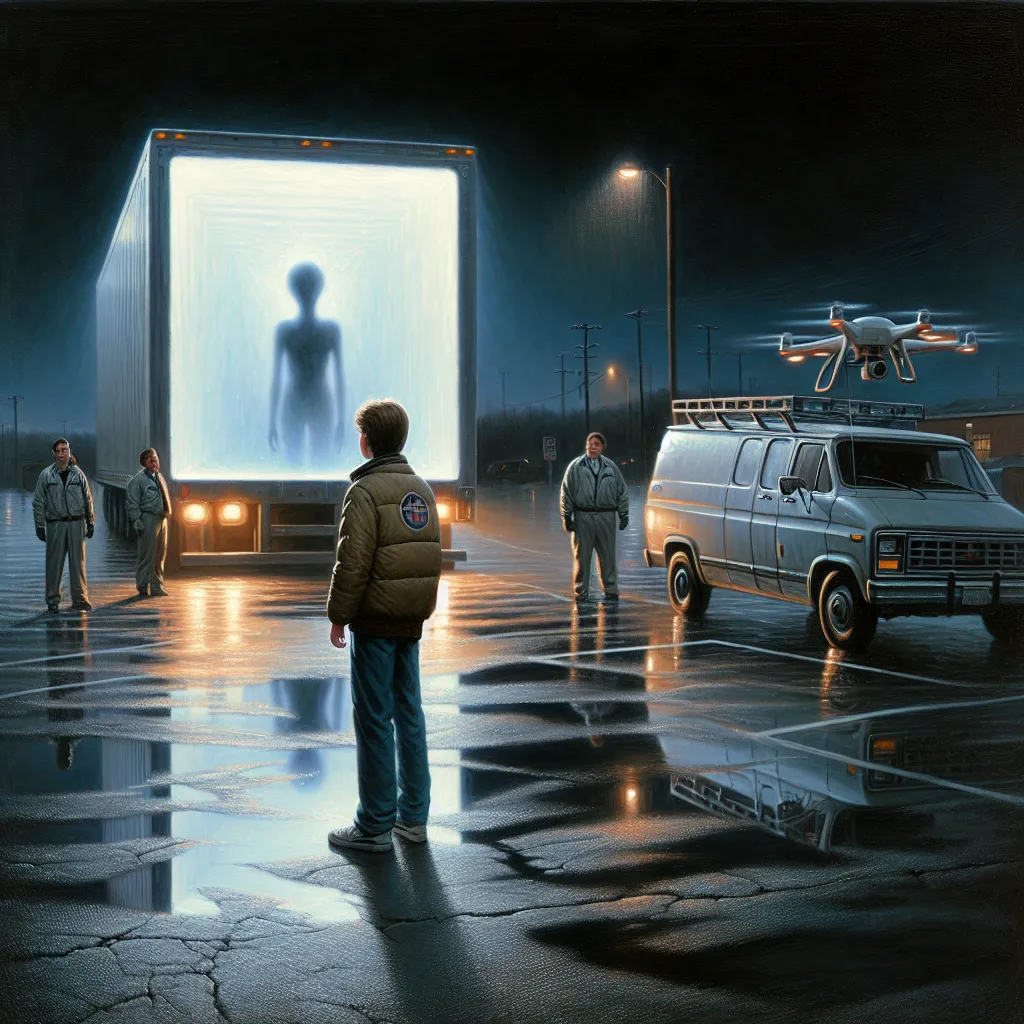
It starts small: a seam in the asphalt that looks like a hairline fracture, then a light leaking out of nowhere, a rectangle the color of bad film. A.D.E.F. It's like the world has decided to cough up a piece of itself; the opening is a door that doesn't know its way. The van's side catches the light. An agent lunges for a net — surely we had nets for this — but as the seam widens the air inside it looks wrong, like a photograph printed on damp paper. It smells of ozone and old sugar.
My throat tightens. Iris, in the van, freezes. They open the doors to secure her and the field spills out a dark like the underside of a word. There is a silhouette in it.
If the rumor had been a campfire story, what we saw would have been its dampening end. The silhouette isn't a monster. It isn't big in the way I had feared. It is a shape that suggests a figure, jointed in human ways but blurred, as if viewed through a frosted pane. It steps out and then the world remembers gravity and the hem of the shadow touches the parking lot and a whorl of dust lifts.
Someone screams. That sound cracks something in my chest and it's a small bright pain that tastes like metal. I feel the first instinct: not to run, but the old reflex to protect. The reflex in me knows an impact and wants to redirect it. My palms go hot. My fingers tingle. The asphalt beneath the van puckers and then shivers, as if it is auditioning for collapse.
This is the moment you've seen on documentaries, if you've watched the wrong ones: the slow, cinematic breach where the world's edge frays and the camera holds on a boy who tastes fear. Behind the agents, the parking lot buckles; telephone poles bend like saplings. The van's lights gutter.
I am thinking of my breath exercises and I am not breathing them. My heart is a hammer. Tears blur sunlight. I remember Seattle, and my muscles coil with a strange, animal knowledge: collapse will form a shell around me. It always did. It has always chosen to eat everything in order to leave me standing.
I clench my jaw, hard. I don't want to be the geography of destruction. I don't want the asphalt where trailers and checkout lines were to become a canyon of loss because I couldn't turn down a noise in my head. I tell myself to breathe like the DBT cards in my counselor's office: S — stop, B — breathe, O — orient. The words rattle, slotted beads on a string. I repeat them like a charm.
Somewhere between "breathe" and "orient", the silhouette looks at me. It tilts, like a question mark. Its outline shimmers. The world holds for a second, like someone has pressed pause on the wrong frame.
"Kelvin," Iris says in a voice that is far too loud. "Don't—"
Her words are a wedge. The agents push forward; one of them slips in the dust. When he does, the asphalt at his foot ruptures in a slow way and the light around the A.D.E.F thickens and swallows the sound of his fall. People scatter like litter.
I do something I didn't know I had in me: I let the collapse happen, but I don't let it be all of it. Instead of hard, jagged collapse I steer the deterioration outward, a controlled erosion. The lampposts sag and bend away in angles that don't take out pylons. The van's rear door folds inward like a book closing; the agents are unhurt but clumsy. The pocket field loses its rectangle edges and becomes a soft waver that sucks at the air.
The silhouette takes a step back. It doesn't seem aggressive. It seems very human in its curiosity and very not in the way a reflection is not. For a blink the two of us — me, the boy who can wear the world like a broken sweater, and this figure who might be a thought made manifest — regard each other like two mirror-images that forgot to be simple. The A.D.E.F pulses. Then, as abruptly and inexplicably as it appeared, the field flutters shut and the silhouette collapses into it. The rectangle slams and the asphalt seams fall quiet.
We all stand there breathing like sailors after a squall. The agent who fell has a scuffed knee and looks like a man who wants to start a story. Iris opens the van's door and steps out, eyes wide and ridiculous and enormous. The men in suits collect data like vultures collecting shiny things. Cameras blink. The drone has a smear on its lens and someone shrieks in the background that the feed will be analyzed.
Afterward, the woman from the Department kneels in front of me. Her face is softer now because the emergency had answered itself in a way that invited curiosity more than doom. "You controlled it," she says. "You prevented structural failure."
Ironic that the sentence felt like praise. "I didn't stop it," I say. "I just — nudged it. I don't know how." My fingers are still buzzing.
Iris stands beside me. She looks young and impossibly old all at once. "It wasn't a predator," she says. "It didn't look like anything I'd seen in the field. It looked like—" She searches for words. "Like a visitor. Like something that stepped out to see if there were people on the other side."
Questions swarm from the agents. Did it have a face, did it speak, did it understand that we were there? They talk about containment protocols, about specimen retrieval, about relocating her for the duration of a twelve-week study. There are words like incident report and Chain of Command. There are cameras aimed at Iris's face like hawks.
Later, in the sterile room where they keep the kids during investigations, I sit across from her with plastic chairs and a sky printed on the ceiling that is too blue. My hands are bandaged with the memory of cold.
"You saw it," I say. My voice is thin. "Did you touch it?"
"No," she says. "But when it looked at me I felt… not fear. Not like before. Curiosity, maybe. It was like someone finding a photograph of themselves they didn't know existed. But Kel, the rumor — the rumor said it was hostile. It wasn't. The way it moved — it moved like a person stepping out of posture."
The government people don't like the "visitor" story. They prefer "anomaly" and "containment." The narrative shifts like staging for a play: press briefings, a field team that takes samples, an older man who talks in soft absolutes on a recorded loop. The rumor becomes a headline because things like mystery sell. Then the headlines become an official denial because the Department can never have the public scared enough to demand answers they can't give.
If the silhouette had been hostile, everything would have gone differently. We would be rebuilding and counting bodies. The fact that nothing broke beyond the parking lot and none of the agents were devoured becomes evidence that protocols work, that the world is not yet on fire because of us. But the rumor lingers because rumors are tenacious. People prefer to believe in monsters. Monsters are easier to understand than the idea that sometimes things happen and nobody knows why.
I go home after the interviews. My mother waits in the living room like a weather vane, hands folded, eyes thinning. She doesn't ask if I'm okay. She doesn't ask how I could do what I did. She simply folds me into herself, like a small animal she keeps warm.
The next day the Department places a semi-transparent injunction on Iris's movements: watchful presence, temporary relocation if necessary. They tell her she is safer with them, and for a while she believes it because the watchers are like glass and the glass means a promise of science. But their presence is also an admission. Someone is curious enough to look at her constantly. Someone thinks the silhouette may have been looking back.
I stop showing my pulse monitor to teachers. I still go to class. Kids whisper and point, but not directly to me. Having A.A.D.S1 in a community saturated by fear and surveillance is like having a satellite over your bed: people check the feed, then look away. I keep playing guitar in the evenings because music is a loop that doesn't ask for breath control.
On a late night when the house is quiet and the city hums like an old refrigerator, Iris calls me again. "Kel," she says, and there is a smile in the sound of it. "It's weird."
"What," I say.
"I think it learned something. Not from us. From the way we handle fear. It stepped out, it saw panic, it stepped back. But then it watched me later, when no men in suits were around. It watched me make tea. It learned to be less like a breaking seam and more like a person waving."
Maybe that is what scares me the most. The silhouette could be a copy of us, warmed by contact. Or it could be something that mirrors us and then grows teeth. Or worse, it could be something that looks at the seams of our world and decides to make its own.
I tell her I will be over in the morning. We sit on the back porch and watch the sky with all its old honest stars. We talk until we are tired, as if normal words can stitch the night back into a durable cloth.
In the end, nothing else happens. The government files another report with careful language. Iris is allowed back home but with frequent visits. The rumor about a thing from an A.D.E.F walking the streets subsides as the town's attention shifts. The man who fell at the parking lot tells his tale, and a loop of civic prayer and calm settles over the school, because that is what communities do when an unexplainable thing nearly happens: they teach each other how to be unbroken, at least in public.
But we change. Iris and I are different because the silhouette leaned and watched and remembered. She is not the same child who could fluster in a doorway. She is steady in a way that looks almost like bravery and almost like apathy. I am different because I learned that sometimes steering a collapse is a choice you must make if you want to keep people from being hurt. The choice is a heavy one, and it sits in my chest like a stone.
People still speak of Seattle in a hushed voice. They still hand out bracelets at school and tell us to breathe when the fire alarms ring. But every so often I meet Iris on the porch and we sit and drink tea and watch the horizon like two small humans who know the world can be soft and it can be hard and sometimes it chooses one for you.
At the fringe of every rumor there is the possibility of explanation. At the center of every explanation, for us, there is someone learning a new way to be human in a universe that suddenly remembered it had holes. We learn to live with that remembering.
And sometimes, late at night, when the house creaks in a way that could be anything, I step out and look at the sky. I don't see a silhouette. I see instead the space between things, which is a quieter kind of luminous. I imagine — because people must imagine in order to keep making forward — that the thing from the A.D.E.F watches back and learns the language of ordinary gestures: the way Iris wraps her hands around a cup, the way I steady a chord on my guitar.
Maybe that's the cruelest thing of all: we are both project and protector. We are both the seam and the hand that tucks it in. The world still feels fragile. But when the field opens, when a rectangle of wrong light cuts out of the asphalt, somebody learns to look at it without flinching. Somebody learns to map the steps of a stranger who is only partly stranger.
For now, that's enough. For now, I breathe and the beads on my wrist stay quiet. For now, Iris is safe, under glass and not. For now, the rumor is a story we can tuck into our pockets and carry until the day it becomes real enough to require another choice.