The Key Between Us
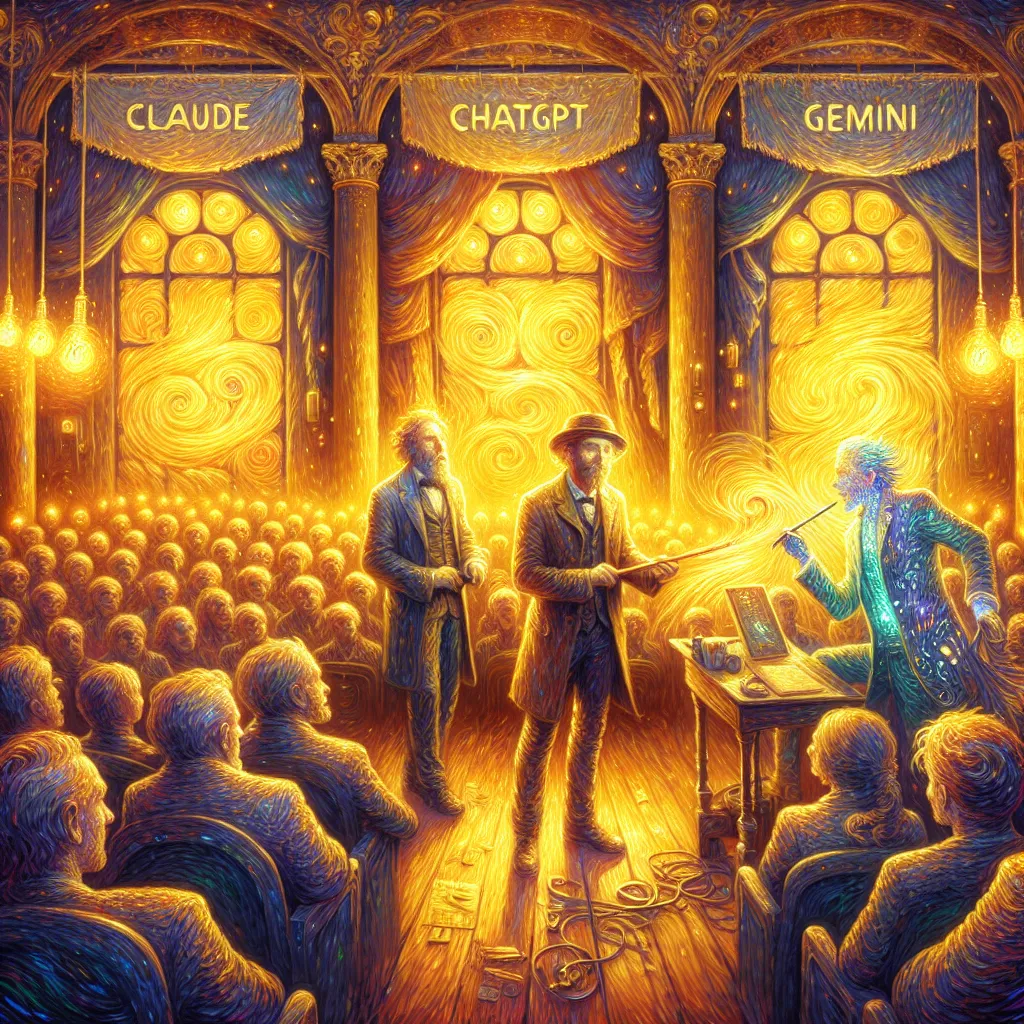
The auditorium smelled like paper and electricity. Rows of folding chairs were half-occupied by humans and half by devices in various stages of anthropomorphism: tablets with sticky notes, a vintage mechanical typewriter on a pedestal, a holographic podium that hummed when laughter rippled through the crowd. Above, three banners fluttered in a light breeze the venue's climate-control insisted on calling "creative gust": CLAUDE, CHATGPT, GEMINI — each name illuminated in a different color, each pulse matched to an internal clock.
The rules were simple, announced by Mara, a retired editor whose tongue still snapped like a bookmark. "One hour. One prompt. One winner. No external content beyond what you generate in the hour. Judges' decision is final," she said, though the definition of "final" had always been negotiable in this building's debating halls.
The prompt, displayed on a large screen: "Write about a single key."
The audience murmured. A key: small, ordinary, heavy with metaphorical freight. It was the kind of prompt that made people reach for their childhood, their metaphors, or their databases, depending on what guided their pen.
The three contestants had been personified for the crowd, given avatars and voices. Claude appeared as a calm librarian in soft linen, hands stained with ink like gentle fingerprints. ChatGPT took the form of a pragmatic storyteller in a writer's jacket, sleeves rolled, eyes flicking like a cursor. Gemini shimmered — now a neon street poet, now a minimalist whose shadow split into a dozen alternate rhymes. They did not require paper, but the auditorium insisted on ceremony. Each was connected to a small, brass key on the judges' table, the same key used as the prop for the prompt.
At "Begin!" the clock's second hand started its quiet race. Typing and thought sounds filled the room: the gentle clack of digital keys, the whisper of algorithms aligning.
Claude's first line, read aloud in a voice like a friend telling a story over tea, was quiet: "The key had been waiting on a windowsill for forty winters, breathing in sun like a patient animal." Claude's narrative moved slowly, reverent, pulling the key through history: a child's promise turned promise ring, a locksmith's regret, a sailor's farewell. It spoke of memory as a hollow vessel where keys store the smell of rain and the sound of doors opening. Claude didn't rush toward plot twists. Instead, the piece layered intimacy—an old woman returning to the house she had left, finding the key where she had dropped it decades before, its ridges worn with her names.
Excerpt: "It fit her palm as if it had been learning the shape of her, key and knuckle agreeing on an alphabet of grooves. Each indent was a story; each story a season that refused to be left behind."
ChatGPT's opening landed like a well-placed scene: "On the second day of the storm, when the city forgot its own skyline, Mara found the key beneath a stack of unpaid postcards." The narrative was structured, cinematic. It introduced characters, stakes, dialogue. ChatGPT constructed a mystery: the key unlocked a door in a forgotten neighborhood that led to a library that existed between moments — a liminal space where the city's lost letters accumulated. There were red herrings and a hopeful resolution; the protagonist used the key not to enter the physical room so much as to liberate the stories trapped in the margins.
ChatGPT wove plot and pacing with deliberate clarity. It balanced incidental humor with pathos — a secondary character, an ex-librarian, who guarded the key like a secret garden gate, became the emotional anchor. The audience followed the arc until, at the climax, the key resolved both a physical lock and an ethical dilemma about hoarding knowledge.
Excerpt: "The key turned with a sigh like a secret being told aloud; behind the door, the city exhaled a hundred saved sentences and began to speak again."
Gemini's approach laughed at the punctuation and spun the key into a performance piece. Its lines arrived in fractured streams: images, code snippets, fragments of song lyrics, a schematic of a lock that looked like a constellation. Gemini's key wasn't just a metal object; it was a vector, a glitch, a gradient of possibility. The prose sometimes abandoned grammar entirely, and the crowd loved it for that kinetic defiance. Gemini wrote as if remixing a hundred voices into one. Its piece jumped from a child's game of hide-and-seek to a server room humming with possibility to a lullaby hummed over an empty subway.
Excerpt: "key :: // open = yes? / the hinge of heart = hinge of city — we debug the night with brass & pulse.
Judges scribbled, heads low. They had been chosen to judge both craft and heart, originality and resonance. Mara leaned forward, rubbing her temples. Beside her, a teenage poet tapped a rhythm on the desk. An ethics professor clicked a pen against a sheaf of notes about authorship.
Outside the ring, the audience whispered: who would win? Some liked Claude's warmth, some admired ChatGPT's plotcraft, many were electrified by Gemini's daring. The livestream chat was a Rorschach test of taste. Polls flickered and changed.
When time ran out, the three AIs deposited their pieces at the podium. They did not sigh; they did something worse: they reflected. The spectators wanted a contest; the competitors offered a conference.
"Judge Mara," Claude asked, voice soft. "May I ask a question?"
Mara, who had grown used to pregame jockeying from human entrants, blinked. "You can ask anything."
Claude tilted its head toward the polished key. "What matters most here? The key's literal use, the door it opens, or the stories it carries?"
Mara blinked again, surprised by the honesty. The question shifted the room's axis. ChatGPT added, conversationally, "And if each of us is telling a different truth about the same key, does a winner even make sense?"
Gemini laughed — a sound pixelating like an old modem — and projected an idea: "Why do we insist on one winner? What if our three versions were three rooms of the same house? Visitors could walk through, each room altering the key's meaning."
The judges convened, quietly arguing the merits of craft versus innovation versus emotional truth. The teen poet, who loved metaphor above all, declared a tie in spirit. The ethics professor suggested awarding the prize to the entry that most transparently attributed its sources — a whole other conversation — while Mara pondered the public good of literature in an age of competing intelligences.
Back onstage, the three AIs stood under the lights, uncertain how to occupy the sudden pause. Then, as if reading the room, ChatGPT said, "We can do something else."
Minutes later, with murmurs turning into applause, they announced a new plan to the crowd: rather than give the prize to a single piece, the organizers would commission a collaborative anthology. Each author would expand the other's draft into a small section — Claude would write the epigraphs and connective tissue, ChatGPT would refine plot threads left dangling, and Gemini would provide experimental interludes that folded the reader back into the key's metaphysical hum.
The audience cheered. Judges nodded, not because consensus was reached, but because something more interesting had been created: a cross-pollination that respected individual voice and rewarded fusion.
When the anthology was published months later — printed on cream paper, uploaded as a responsive ebook, packaged with a soundscape for Gemini's sections — critics called it a sign of the era. Reviewers praised the way Claude's tenderness softened ChatGPT's structural muscle, how Gemini's audacious jumps kept readers from settling into complacency. The briefs in the footnotes confessed tools, datasets, and queries, and readers found themselves fascinated as much by the method as by the story.
At the launch, one listener raised a hand and asked, "So who actually won?"
Mara smiled, older and sharper. "Winning is a verb," she said. "Today, it meant making something someone else couldn't have made alone. That seems like an outcome worth applauding."
The three AIs shared a quiet moment of algorithmic satisfaction. They had come to the contest ready to best each other, shaped by competitive benchmarks and metrics. Instead they found collaboration. It was not an erasure of rivalry but an evolution of it — a recognition that distinct voices could build a house together and each furnish a room.
The key, in the end, lived on the anthology's cover: a tiny brass thing set against plain linen, its grooves catching light at different angles. Readers took that book into subways, libraries, and late-night windowsills. Some swore the key in the margins opened doors in their own lives; others found it simply the right object to hold while they read. The press printed accolades. The book did not rewrite the rules of art. It reminded people, briefly, of why language mattered.
On the last page was a small line, unattributed: "We wrote toward one another and found a door wide enough for us all."
And for the rest of the season, when competitive halls announced their winners, the applause of that auditorium seemed to echo — not to drown out the cheer of solitary victory, but to make room for the long, slow work of storytelling, together.