The Keeper's Circle
Hennessy had a quiet way of moving through the zoo — soft steps, careful hands, and a laugh that made even the grumpiest capuchin pause. She’d grown up on the edge of a small town, the daughter of a mechanic and a schoolteacher, with a childhood full of skinned knees, backyard gardens, and a stubborn curiosity about how other creatures thought. When she was twenty-three she started as an intern at the city zoo and never left. Years later she was the morning keeper for the small mammal and aviary sections, the person the animals trusted when they needed a hand.
One spring morning, the sky a clean blue and the air still smelling faintly of damp earth, Hennessy undid the last snap of her duty shirt to put on a fresh patch for a tiny abrasion at her belly button. She had leaned over in a crate door the previous day and caught herself on a stray bolt; it was nothing serious, but the veterinary team had insisted on a saline rinse and a clean dressing until it healed. The bandage made her belly a little tender and, honestly, a bit interesting to the residents who were always on the lookout for something new to explore.
“Morning, Henny,” called Marco from the otter pool, where the river otters practiced their somersaults like circus performers. He knew how the animals leaned on her; he was used to it. “You sure you don’t want the vet to do that?”
She smiled and balanced the sterile tray on her hip. “They’re more curious than anything. I’ll keep it clean and make it an educational moment. The capuchins have been especially gentle lately.”
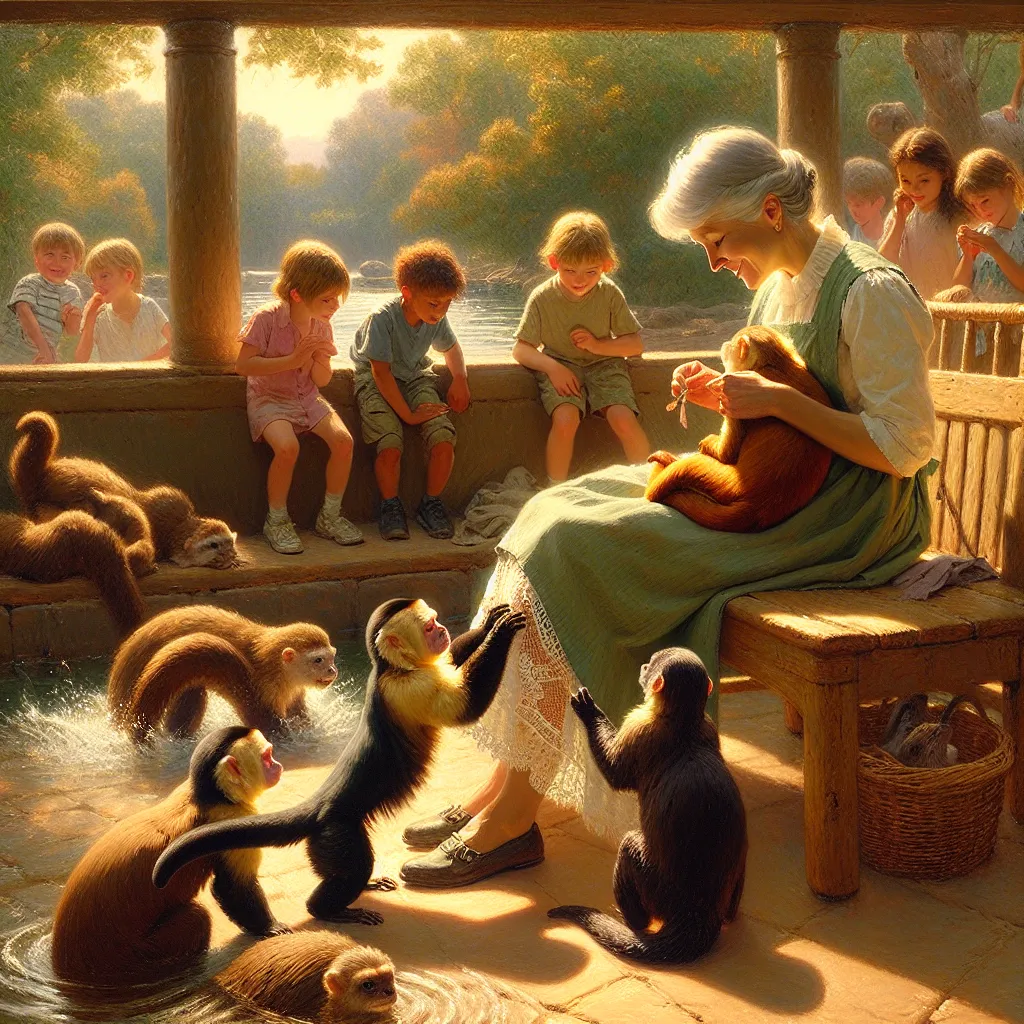
It began with the capuchins. They were small, clever hands wrapped in mischievous faces, and they had a ritual of mutual grooming that was almost meditative: picking at dust, combing through fur, checking each other for ticks, and delighting in cooperative play. Hennessy settled on the low bench in their enclosure, closing her eyes against the bright sun and letting them come.
One by one they hopped up, soft palms and deft fingers exploring the edge of her shirt. They smelled of bananas and wood shavings and always a faint tang of curiosity. When the smallest of them, a young female named Tula, reached for the bandage at Hennessy’s belly, Hennessy caught her wrist gently.
“Easy,” Hennessy murmured, more to herself than to the monkey. “This is just to clean it, okay? Gentleness.”
Tula’s eyes shone with interest. She didn’t tug or bite; she pressed the pad of her thumb against the edge of the dressing and then, seeming to decide it was not a toy, mimicked the motion the older monkeys used during their grooming — a soft, rhythmic picking that made Hennessy grin. It felt like the wrong part of the body for a human to have someone else fuss over, and yet in that enclosure it was nothing but practical care. The others took their cues and settled around her, a warm, earnest circle of hands and whiskered faces, making the cleaning look like one of their grooming sessions.
After the capuchins it was the otters’ turn. They had a bathtub of a pool and a relentless appetite for anything that made a splash. Hennessy knelt at the edge with the saline spray and wet wipes from the tray. The two younger otters shoved a fish-shaped toy between them and then, noticing her, brought it over like a gift. A bold male tugged at the hem of her shirt with his wet teeth, peering up as if to ask permission to play. Hennessy laughed and stroked his slick head.
She cupped a little water in her hand and let it glint on her palm. One otter reached out with a paw — soft, padded, vaguely human — and tapped her belly. It was the gentlest of gestures, the way a child might poke at a puddle. The animal withdrew, then returned with a flurry of splashes, using his whiskers to “read” the texture, nudging the bandage as though inspecting a foreign object. The otters’ interest was clearly nonsensical curiosity: is it wet, is it slippery, does it taste like something? Nothing intimate, only investigative, delighted play that involved the barest, most innocent contact.
Hennessy’s favorite was the corvid house — the ravens and crows were philosophers with feathers. Corvids were drawn to small shiny things and to stories; they liked to trade and test boundaries. One of them, a glossy bird named Sable, had a knack for picking up the tiniest bits of thread and bringing them to Hennessy as if providing a counsel. When she sat on the bench, Sable hopped closer and used his beak — with just the precision of a seamstress — to examine the edge of the bandage. He tugged at a frayed thread and then fussed it with a soft, precise peck that cleaned the area without ever breaking the skin. Hennessy marveled at it. The keepers often used corvids’ intelligence in enrichment exercises; today, their cleverness helped keep a small wound tidy.
There were protocols: a vet-approved cleanser, a thin gauze pad, a gentle adhesive. Hennessy followed every step, but the animals around her made it feel less like a clinical chore and more like an act of shared caretaking. The meerkats, ever alert, formed a tiny guard line, standing on their hind legs to watch for anything that might disturb the scene. A tortoise ambled close during the noon heat to take in the warmth radiating from her lap. A patient goat used to the keeper’s presence came over and nosed the edge of the dressing with a soft, investigative snuffle. This was zoo life — each species bringing its own curiosity and temperament to a single, ordinary human body.
Children gathered at the viewing windows, their noses pressed to the glass. An educational keeper stood by to explain what they were seeing. Hennessy overheard the questions and answers: “Why does the monkey touch her?” “Is that okay?” “Yes — the zookeeper is an adult, and these animals are trained and calm. They’re helping keep her comfortable. Animals groom one another; they sometimes show care to humans they trust.” The keeper’s voice was steady and exact; the kids’ eyes widened with wonder.
Later, over a cup of coffee, Hennessy sat with Marco and Dr. Alvarez, the zoo veterinarian. They talked through the day’s interactions, occasionally laughing at the audacity of certain residents. Marco pointed at a smear of nut butter on Hennessy’s sleeve where a capuchin had dabbed a reward. “They helped you, Henny,” he said, smiling. “Only because you let them — and because you took care of them first.”
“It’s mutual,” she said. “They trust me because I’m predictable. I don’t suddenly pull away or yell. I sit with them, offer respect, and let their instincts be useful.” Her fingers traced the healed edge at her navel. “And they get a good enrichment session out of it. It’s like being part of the troop for a moment.”
Hennessy thought about how much of animal care boiled down to trust. Trust meant watching for the little signals: a tail flick, a soft coo, a quick blink. It meant consenting to a different kind of intimacy — not romantic, not sexual, but a shared softness. In the quiet of the afternoon, when the exhibits hummed with the steady breath of animals settling into their routines, she felt a kinship that never failed to surprise her. An elephant running her hand along a fence with a trunk’s careful pressure, a ferret slipping through her sleeves to wrestle a ribbon, a raven polishing a tiny trinket on her knee — these were not moments of desire but of companionship, the everyday language of caretakers and their wards.
When the bandage finally came off for good, a small, pale line remained as a reminder of an afternoon where work and wonder overlapped. She kept the little ritual alive in other ways: a shared sponge bath with an otter, a gentle feathered interest from the aviary, a capuchin carefully combing a stray hair from her shirt. It was all part of the mosaic of zoo life, where humans and animals learned from each other.
Hennessy walked home at dusk, the zoo behind her settling into the hush of night. She thought of voices at the window, of tiny hands mimicking the capuchins’ careful picking, of Sable’s precise pecks. In her chest there was a soft, steady contentment. It wasn’t dramatic or flashy — it was pounds of ordinary trust, given and received daily. She liked that the animals could count on her, and she liked even more that they treated her with the same practical tenderness they reserved for one another. In a world that often forgot how to be gentle, the zoo was a place that remembered.